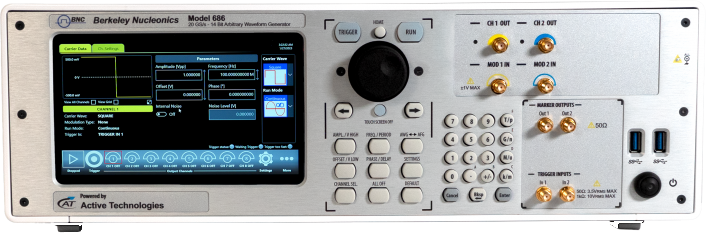
SAN RAFAEL, Calif., May 25, 2026. Berkeley Nucleonics Corporation (BNC) is highlighting the Model 686 arbitrary waveform generator, the fastest 14-bit AWG in the company's lineup, for engineers evaluating high-speed signal generation across research, defense, industrial, and academic test applications. The instrument pairs a 20 GS/s real-time sample rate with true 14-bit vertical resolution, a combination that lets engineers generate high-fidelity signals without trading accuracy for speed, or the reverse — and it holds that resolution across a measured 3 dB bandwidth of 5.8 GHz (sin(x)/x compensated), with a square-wave rise and fall time of 120 picoseconds and output amplitude up to 5 Vpp at frequencies to 3.5 GHz.
Signal generation scales with the test program rather than boxing it in. Each Model 686 offers 2 or 4 fully synchronized analog channels alongside up to 32 digital lines for mixed-signal work, and a dedicated intra-chassis synchronization bus links up to four units into a single 16-analog, 128-digital-channel system without losing timing accuracy. Up to 9 Gpts of waveform memory per channel in Full Rate mode leaves room for extensive waveform data and multi-step test sequences, so a growing program doesn't outrun the instrument underneath it.
One instrument, three operating modes
The included Simple Rider software covers the ground that would otherwise take three separate instruments: an AFG mode for straightforward function generation, a True Arb mode for variable-clock arbitrary waveforms, and an optional Pulse Pattern Generator (PPG) mode for PRBS and multi-level PAM patterns, including custom patterns up to 12 megasymbols at pattern rates up to 6.5 Gbaud. All three run from the same touchscreen-ready interface, so engineers move between waveform creation, sequencing, and pattern generation without switching software or re-learning a workflow.
That range of capability is why the Model 686 turns up in such different settings. It supports semiconductor test and device characterization, quantum key distribution and quantum sensing research, RF and wireless communications work, aerospace and defense applications, and optics and photonics research — often within the same lab, on the same instrument.
“The Model 686 is the instrument I point customers to when they need serious speed and resolution without picking between the two,” said David Gil, Technical Sales Representative at Berkeley Nucleonics. “It shows up on test benches solving very different problems — semiconductor validation one week, a photonics lab the next — because 20 GS/s at 14 bits is useful anywhere signal fidelity matters.”
Availability
The Model 686 is available through Berkeley Nucleonics and its representatives worldwide. Full specifications, configuration options, and quote requests are on the Model 686 datasheet page.
About Berkeley Nucleonics
Berkeley Nucleonics Corporation (BNC) has been a trusted name in precision electronic instrumentation since 1963, serving defense, research, academic, and industrial customers with digital delay generators, arbitrary waveform generators, RF/microwave signal generators, pulsed power systems, and nuclear radiation detection equipment. With 60+ years of reliability and responsive technical support, BNC is flexible and listens to your application.
Media contact
Eriberto Salgado
Berkeley Nucleonics Corporation
eriberto.salgado@berkeleynucleonics.com
800-234-7858
Technical contact: Amira Sekkouty, amira.sekkouty@berkeleynucleonics.com